My Learning Disability


headphones 3 WAYS TO LISTEN

1. Click the icon on the right to listen to the full article.
2. Right-click here and “save as” or “save link as” to save an mp3 of the article to your computer.
3. Listen to sections of the article by pressing the play buttons that appear before a set of words in the article below (coming soon).

My Learning Disability


Tammy Roya

BEFORE YOU READ:
1. Read the subheadings. What do you think the
sequence of this story will be?
2. Share what you know about learning disabilities. What are some examples of learning disabilities and differences? What is your experience with them?

As a Child: Pushed Around and Left Behind

I am learning disabled. All my life, it has been more than a long road.

When I was in school, kids treated me badly. They made fun of me and called me names. They also called me “teacher’s pet” because I had to have a lot of help. They pushed me around the playground and beat me up. When we did school projects in groups, no one wanted me. The teacher assigned me to a group, and all those kids would be mad to get me. They told the teacher they didn’t want me. They said I would slow them down.

When I got to high school, it was no better; it just got worse. I went to special classes, but I wasn’t learning anything. The class was for two hours a day, which wasn’t long enough to help me with my learning disability and all my schoolwork. The school kept moving me up, and I probably would have graduated, but by 10th grade, I couldn’t do it anymore. I was so behind. I was only at a 4th grade reading level.

Paying Bills and Having Kids But Still Can’t Read

I was 18 years old, so I got a job and moved out of my foster home. I moved into my own apartment, but I could only work as a dishwasher. I had lots of bad times trying to pay the bills and the rent because I couldn’t write checks.

When I was 20 years old, I had my first baby. By the time I was 24, I had 3 kids. When my kids were babies, I had trouble learning how to take care of them. My mind was slower than everyone else’s. I couldn’t read about how to raise them.

I struggled with all the paperwork for doctors’ and dentists’ appointments. I struggled to read important letters that came in the mail. I had to get on Social Security because I couldn’t keep a job.

My Kids Had to Ask Others for Help

When my kids were in grade school, they were getting mad at me because I could not help them with their homework. They were smarter than me. I felt really bad. I cried myself to sleep most nights knowing that I couldn’t help them and made their life more difficult. They had to stay after school and ask classmates and teachers for help.

My kids did well in school, and they graduated. Thank goodness for other people who helped them. I wish I could say I helped them get there, but I did not.

Finally Getting Help for Me

When I was 25 years old, I decided to go to Dover Adult Learning Center to continue my education, and I have been attending on and off for many years. I got tired of being so learning disabled and struggling so badly. I struggle with memory and reading comprehension. I am now 58 years old, and I’m attending classes regularly. I need to keep my brain from losing what I’ve learned, and I want to try to learn more. I am moving up some grade levels, but I know because my learning is so bad that I will never get my high school diploma.

I’m thankful for being on Social Security because I would have been homeless with my kids long ago. I couldn’t keep a job then or now. These days, it would be harder to get a job because you have to fill out job applications online, and I don’t know how to work a computer. But I keep trying to learn. I am taking a class in computers for beginners.

I won’t give up even though every day is still hard for me. I hope you don’t give up either. You can get yourself out of bad stuff if you try. If I can do it, you can too. Just get help if you need it. It is better than living in misery.

AFTER YOU READ:
1. According to what the author says and what you can infer, what supports have been available to Tammy and what supports were missing?
2. What do you think about Tammy’s advice at the end of the article?
3. Read and discuss the box on the right. What do you think of the two definitions of disability?
What do you think of the phrase, “Nothing about us without us”?


Tammy Roya is a student at Dover Adult Learning Center in Dover, New Hampshire. She likes to take long walks and bike rides in the woods. She also enjoys camping and arts and crafts.
Back to Issue 65

Reading Challenges


headphones 3 WAYS TO LISTEN

1. Click the icon on the right to listen to the full article.
2. Right-click here and “save as” or “save link as” to save an mp3 of the article to your computer.
3. Listen to sections of the article by pressing the play buttons that appear before a set of words in the article below (coming soon).

Reading Challenges and…
Many Strategies for Learning to Read

Deb Coates

BEFORE YOU READ:
What was it like for you to learn to read? What strategies have you used?

When I was in grammar school, I only learned how to read three- and four-letter words. I had to repeat two grades, but I did graduate 8th grade. I am not sure how. Even then, all I could read was three- and four-letter words. I felt like a failure.

Why didn’t I get more help from the teacher? Looking back, I think she taught two grades combined. She had a lot of students with different needs. I wonder if it was too much for the teacher. Maybe she was overwhelmed by too many students.

I didn’t get my driver’s license until I was 27 because it was so hard to read the manual. On the day that I took the test, my examiner’s wife was in the hospital having a baby. Her name was Debra, the same as mine. Well, I got four wrong on my test, and you were only allowed to get three wrong. My examiner passed me anyway. He said it was my lucky day, and he told me why. So, do you think that was lucky or what?!

I got married and my husband tried to teach me how to read better. He did the best he could, but where I really learned was a show called Shepherd’s Chapel. This show had closed captions. The pastor read from the Bible, and the words showed up on the bottom of the screen. I followed along with him. That’s how I learned to read some new words. Now, closed caption is available for any show to teach you the words.

When I turned 72, a friend showed me how to join a class on Zoom at The Literacy Project. I didn’t have to leave my home to learn. I feel safer in my own home than out in public. This helps me focus. When I got onto Zoom, I was nervous until I met my teacher. She made me feel at ease.

She taught me how to break down words and how to pronounce them. I learned about verbs and nouns, so I could write full sentences. And that led to writing short stories. I wish I had a teacher like her when I was a kid. If I had learned to read and write, I could have gone further in my life.

For my whole life I have bluffed my way through, telling people I forgot my glasses so that they would read for me.

I feel like I am in a new world now that I can read. I have a new life. I can read newspapers, books, and lots more. If you are having a hard time reading, I hope my story will help you. Try different strategies until you find something that works for you.

AFTER YOU READ:
1. What strategies did Deb use to learn to read? What has worked well for her?
2. What does it mean to bluff your way through?

Deb Coates is a student at the Literacy Project in Amherst, Massachusetts. She says, “It feels good to be able to read now!”

Back to Issue 65

Something’s Happening in Texas! Excellent Teachers and Powerful Writers Champion The Change Agent

Excellent Teachers and Powerful Writers Champion The Change Agent

It started with The Change Agent receiving scores of submissions through a handful of teachers at a community learning center in El Paso. “What is this powerhouse of an adult learning center?” I wondered. “What are the teachers doing to generate so much powerful writing?”
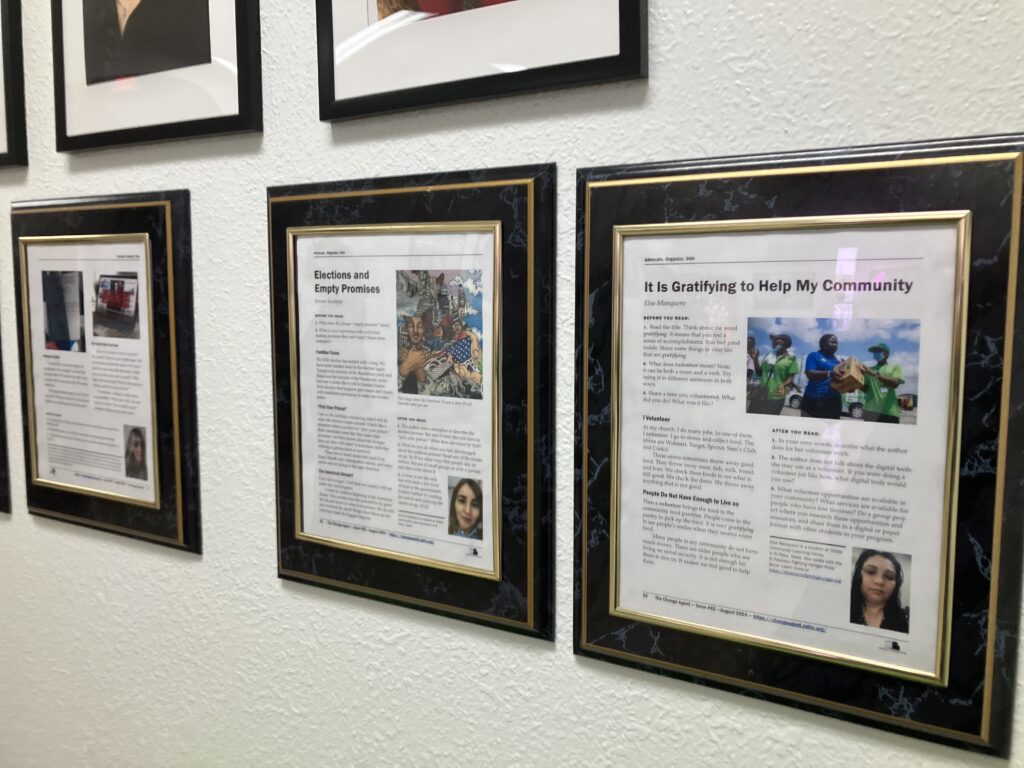
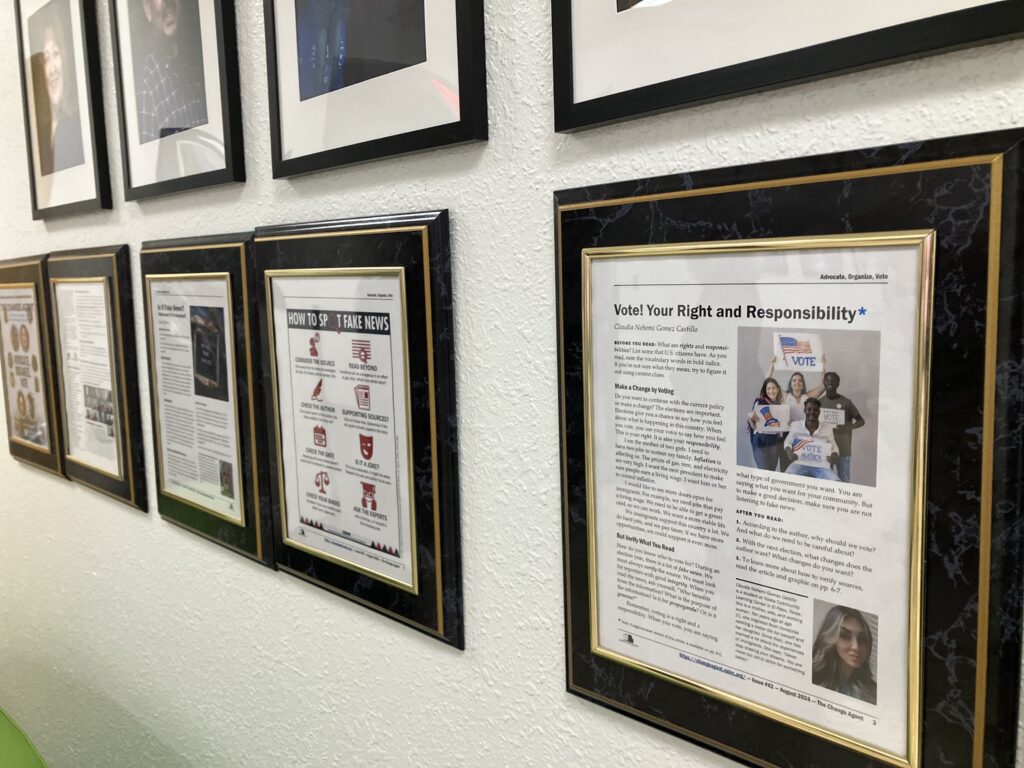
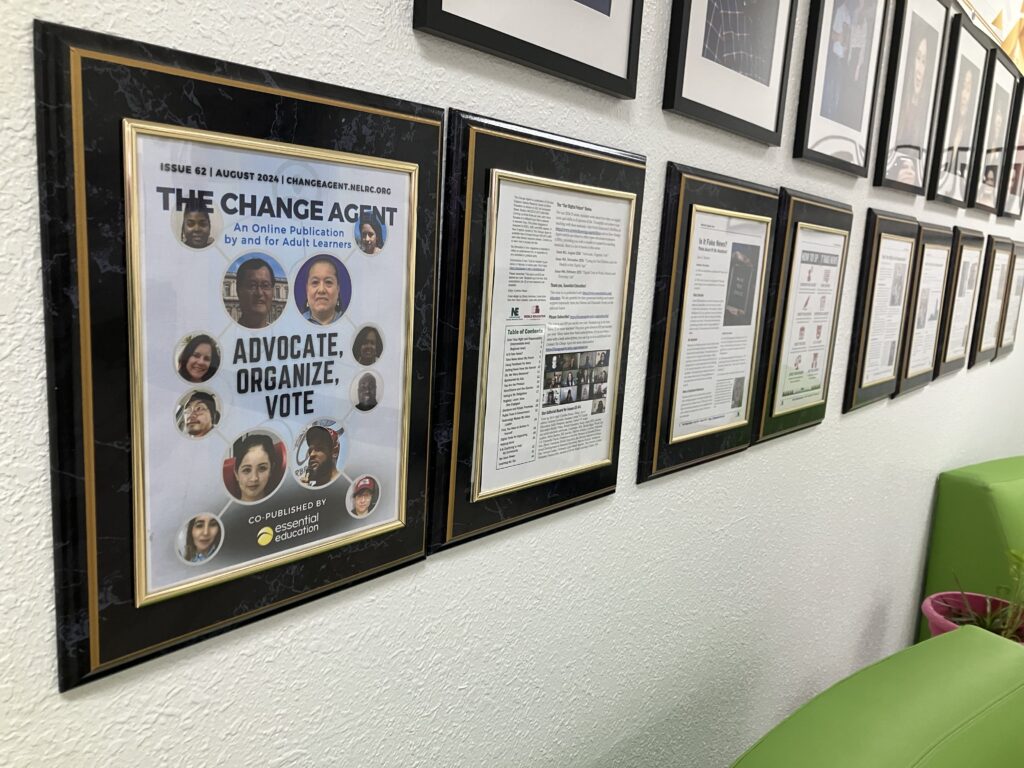
These teachers were (and still are) taking advantage of Texas Center for the Advancement of Literacy & Learning (TCALL)’s statewide bulk subscription to The Change Agent. Like other teachers across Texas, they are bringing relevant, engaging student-written essays into their intermediate and advanced English classes and using them as models of writing, so their students can read content written by their peers and thus see themselves as potential writers as well. The strategy is working! Dozens of students at Ysleta Community Learning Center have been published over the last few years. Their words have reached thousands of students all over the country, inspiring them with their ideas and perseverance in the face of many obstacles. Their words are also framed and hung on the walls, greeting their fellow students and visitors with the reminder that all voices matter.

In February, I was blessed to spend time in El Paso with these teachers and others from nearby learning centers. Although I was there to share my knowledge, I quickly discovered that several of the teachers themselves had already developed trainings on how to use The Change Agent in the classroom. I know something about the depth and breadth of Change Agent resources, but these teachers are the true experts. They are in the classroom every day — using the materials, seeing what works, noticing what resonates with students, and developing creative and powerful extensions.

So we decided to collaborate on a statewide presentation, which we did in March 2025. Two teachers (Georgina Tena and Heidi Nava) and one student (Antonio Carreon) co-presented with me on what The Change Agent has to offer. The teachers shared their favorite articles, teaching strategies, lesson plans, and activities. The student read his article out loud and shared what it was like to engage in the writing process.

Something is happening in Texas, indeed! Teachers and students are not just incorporating The Change Agent into their teaching and learning, they are taking the lead on sharing this resource with others!

Are you a teacher or student using The Change Agent? We can collaborate or support you to achieve your goals. Contact us at changeagent@worlded.org to learn more.

How to Check for Fake Websites


How to Check for Fake Websites


Anonymous

BEFORE YOU READ:
1. IP stands for Internet Protocol. An IP address is numeric label assigned to every device connected to the internet.
2. What guidelines do you currently use to decide if a website is trustworthy?

Protect Yourself from Viruses
There are many fake websites. If you visit a fake website, you could get a virus that tracks your data, your private information, and your IP address. Here are some steps you can take to help you avoid getting scammed or even tracked by a fake website.

Is It Up to Date?
First, open up your computer and go to any website. Check at the very bottom of the website. You should see the date right next to the copyright or trademark section to ensure the website is up to date.

Is It Secure?
Second, check to see if the website is secure to use. Click on the secure lock icon right next to the website address bar, and you should be able to see if the website is secure or not.

Don’t Click on Pop-Ups
The third and final way is to AVOID pop- ups. If you ever get to see a pop-up or a fake virus detector, avoid it. If it keeps popping up constantly, always to be sure to update your browser or get yourself a pop-up blocker. To get a pop-up blocker, go to any of the app stores and read the reviews.

Got a Virus? Get Help!
If your computer is infected with a virus, there are people who can help you get rid of it or recommend antivirus software. Call a legitimate customer service number. Be sure you are talking to the right person. Make sure he or she has good knowledge about computers.

AFTER YOU READ:
1. Open your browser and visit some websites. Use the author’s suggestions to check if the website is fake.
2. If you need help with your computer, who could you talk to?


Anonymous is a student at Delgado Community College in New Orleans, Louisiana.

Back to Issue 64

Dear Cybernauts


Dear Cybernauts:
Do Not Trust Anything Online, At All


Say Cordero

BEFORE YOU READ:
1. Who and what do you put your trust in? If you’re not sure you can trust someone or something, what do you do?
2. A cybernaut is someone who uses the internet. Are you a cybernaut?

I Was a Victim
The internet is not a safe place. There are many ways to be a victim of a scam. Criminals will steal money from your bank account, run up charges on your credit card, and open utility accounts in your name. These days, learning to be safe online is as important as learning to read and write.

When I was younger, I signed up to take a course about how to trade in the stock market. I trusted the school, and I shared my personal information. I also paid for the course, and the person who I talked to disappeared with my money. He also smashed my dreams.

I Learned from the Experience
That experience made me sad, and I felt like a fool. But it also changed me for the better. After the storm passed, I thought about how vulnerable we are online. I realized the starring role that online safety can (and should) play in our life. I learned to be more cautious online, to use only verified sites and browsers, to read reviews, and ask my friends and family for advice. I also learned never to share personal information online unless I am 100% sure that it is safe.

These days, online fraud is increasing. The numbers do not lie. According to the Insurance Information Institute, “The Federal Trade Commission … took in over 5.39 million reports in 2023, of which 48 percent were for fraud and 19 percent for identity theft.”1

It looks like there are millions more people besides me who have been victims of scams and fraud! This is a problem that is getting worse. We need to pay more attention to it.

Stay Safe Online
Criminals are waiting for you to make a mistake, so they can take everything from you. Remember: if it sounds too good to be true, then it probably is. Here are some useful recommendations to keep you safe online:2

  • Be careful with emails from people you don’t know.
  • Be careful with links and new websites.
  • Secure your privacy; use strong passwords.
  • Stay informed on the latest cyber threats, and keep your anti-virus software up to date.

By following these tips your journey online can be a nice trip, dear cybernauts. Technology is better when we use it safely.

Sources: 1. Facts + statistics: Identity Theft and Cybercrime: https:// www.iii.org/fact-statistic/facts-statistics-identity-theft-and-cybercrime.
2. Federal Deposit Insurance Corporation https://www.fdic.gov/ resources/consumers/consumer-news/2021-10.html

AFTER YOU READ:
1. What happened to the author after the storm passed?
2. What does it mean when something is too good to be true?
3. Read more about security in the article on p. 37 and try the free classes listed there.


Say Cordero is a 30-year-old ESL student from Venezuela. He is a tech-, Sci-Fi-, and cat-lover who has been studying English for four months at the Guadalupe School in Salt Lake City, Utah.

Back to Issue 64