I Like to Be Heard


headphones 3 WAYS TO LISTEN

1. Click the icon on the right to listen to the full article.
2. Right-click here and “save as” or “save link as” to save an mp3 of the article to your computer.
3. Listen to sections of the article by pressing the play buttons that appear before a set of words in the article below (coming soon).

I Like to Be Heard

Kristal L. Santos

BEFORE YOU READ:
What do you think the author means by the title?

I Stayed in a Corner
As a child, I would not speak. I had some trauma in my life that affected my ability to say what I was feeling. I could not put my feelings into words. I stayed in a corner and played by myself.

When the adults in my life did not understand me, I got frustrated and angry and acted out. I communicated by pointing at pictures in books and magazines. Later, when I had a cell phone, I took pictures of myself in order to tell a story. That’s how I expressed myself.

The World Judged Me
As a child, I had a learning disability and a speech impairment. It was very difficult for me to be heard. These difficulties affected my teen and young adult years. I became a single mother, and the world judged me. I received help from social services. But not for long. They said I was not competent to raise my children because of my education and my learning disability.

I tried to speak up for myself, but I felt that I was not being heard. I felt that other people were more educated than I was. I believed they were better than me. This was not helping my self-confidence.

Sometimes, the people in my life used my disability as a weapon to their advantage. Their information and guidance did not help me. I did not trust them. I was always angry and sad. I cried a lot, thinking that I was not being heard every time I spoke out loud.

I Found Faith and My Voice
Then one day in my young adult years, I was walking down the street with my mother. She was talking. I was talking. I turned and saw a church.

All of a sudden, I heard a voice. And that voice caught my attention. The voice was telling me that this will be the church that I will attend.

I was looking for a church at the time. I had prayed that God would point out a good church. This is how I found faith. This is how I started on the road to being the person I am today. My faith helped me conquer the things that I needed to conquer—like speaking out loud.

Now, people can hear me. I am learning to advocate for myself. Recently I had to demand that a false description of my abilities in an official job referral be corrected. It wasn’t easy. I followed my inner voice.

AFTER YOU READ:
What are some to the ways Kristal has not been heard in her life? Share some ways you have been heard or perhaps not heard in your life.


Kristal L. Santos attends the Bridge Program at the Community College of RI in Providence, RI. She loves making specialty salads for members and staff of the Hillsgrove Clubhouse, a member- and staff-run mental health recovery program. She sincerely wishes readers of this article will be inspired to speak out and be heard!

Back to Issue 66

A Stroke Survivor Speaks Up


headphones 3 WAYS TO LISTEN

1. Click the icon on the right to listen to the full article.
2. Right-click here and “save as” or “save link as” to save an mp3 of the article to your computer.
3. Listen to sections of the article by pressing the play buttons that appear before a set of words in the article below (coming soon).

A Stroke Survivor Speaks Up

One Step at a Time

Ashley Patterson

BEFORE YOU READ:
What is a complaint? Have you ever had to file a complaint? What happened?

The Shower Is Not Clean
I’m 34 years old. I’m a stroke survivor. I live in a rehabilitation center. Unfortunately, we only take showers once a week. It’s a process. I need two CNAs to help me get into the shower chair. They wheel me into the shower, and I get undressed.

You might think I looked forward to taking a shower. But I did not. The shower was not sanitary. I noticed the tiles were rotting. And it smelled like mold and mildew. I didn’t want to go in there. I hated the smell. I knew something had to change.

Making a Complaint
I thought it would be good to contact the state to file a complaint. But the state asked if I had notified management. They wanted me to do that first before they got involved. They said maybe management would solve the problem without having to get the state involved.

The reason I didn’t reach out to management is that I felt scared. I felt like it shouldn’t be my responsibility to speak up about the condition of the showers. I didn’t want to ruffle any feathers here. I don’t want to make folks angry with me, and I don’t want to get staff in trouble. I have to live here. I am dependent on the staff.

My dad is in a nursing home, and I asked him about how the showers are at his place. He said they were clean. That helped me feel like it is not too much to ask for clean showers.

They Took Me Seriously
So I decided to email management. Almost right away, someone from operations came to my room and talked to me. He said that everything would be addressed. He took me seriously. It really helped. It made me feel seen.

They addressed it in a timely manner. They fixed the tiles, and they added more ventilation. It doesn’t smell moldy now. Now I’m happy to take a shower there. I told my mom about what I accomplished. She was proud of me.

I Have a Voice
It felt great to take this action. I felt empowered. I know I have a voice. I feel like I need to speak up more in situations like this. For example, my wheelchair needs a new battery, and I am having a hard time getting one. I am not satisfied with how they are responding to me. I will keep working on it. One step at a time.

AFTER YOU READ:
1. What does the author mean when she says she didn’t want to ruffle any feathers?
2. What steps does the author take to address the problem of the shower not being clean?
3. Assume it’s you having a similar problem. Compose a letter to management. Share and discuss your letters as a class.
4. Jill Bolte is a stroke survivor. Look up her TED Talk and watch it online.


Ashley Patterson lives in Massachusetts. She hopes that this piece serves as a reminder that we all have a voice, especially people with disabilities.

Back to Issue 66

Speak, So that I May See


headphones 3 WAYS TO LISTEN

1. Click the icon on the right to listen to the full article.
2. Right-click here and “save as” or “save link as” to save an mp3 of the article to your computer.
3. Listen to sections of the article by pressing the play buttons that appear before a set of words in the article below (coming soon).

Speak, So that I May See

Olga Bechelene

Speaking Cities Help People Who Are Blind
Have you ever tried crossing a road with your eyes closed? Or taking public transportation? Or finding the entrance to an unfamiliar building? These everyday tasks can be difficult even for those with perfect vision. For people who are blind or visually impaired, these tasks can be dangerous. Fortunately, technology is here to make our life easier.

One unique innovation is a system called Speaking City, developed by a group of engineers in Saint Petersburg, Russia. This system allows visually impaired people to cross streets safely, board the correct bus, and locate building entrances.

How Does the System Work?
The Speaking City system consists of radio signals installed at key public locations. Users carry a special push-button device or use a smartphone app that connects them to the Speaking City system. When a blind pedestrian approaches an intersection, the system announces the name of the street and warns the pedestrian when the green light is about to end. Thus, a blind person can feel safer when crossing the street.

At bus stops, users receive voice messages with helpful information, such as the name of the stop, which buses stop there, and the expected arrival time. When a bus approaches, the system informs the user about the route number, direction of the travel, and the door location. The user can even notify the driver in advance that they plan to board.

If a blind person wants to enter a public building, the system can help with that too. It announces the name of the facility and warns about any steps or ramps. It even lets the user remotely call for staff assistance if needed. Recently, Speaking City was integrated with intercom systems in residential buildings which helped people not only find the correct entrance, but also open the door remotely

No One Should Be Left Behind
The Speaking City system is an important step toward a more friendly urban environment. By helping visually impaired individuals navigate with confidence, cross the streets, take transport and find buildings, they can feel more independent and the city can enjoy their participation. No one should be left behind. As we continue to develop smarter cities, visually impaired people will be better integrated into society, and that is good for everyone!

I Had a Small Role!
I knew one of the team members who brought the Speaking City system to life. Her name is Maria Romashova. I used to be her English tutor. Then she asked if I could work with her colleagues too. So I taught English to the managers and the engineers at her workplace.

I was so happy to notice recently that Maria Romashova won an award: Best Social Entrepreneur. Looking back at the time I was connected to her project, I remember how much enthusiasm I felt. I was so energized by the work, by the people, and by the sense of purpose. Sometimes I miss that feeling—the sense that I mattered.

Sources:
https://vk.com/@speakingcity
https://sberbusiness.live/publications/govoriashchii-gorod
https://bearr.org/regional-news/social-entrepreneurship-awards-announced-in-moscow/

AFTER YOU READ:
1. According to the author, what is a speaking city?
2. Does your city have any “speaking” elements? If so, describe them.


Olga Bechelene is a student at Shoreline Adult Education in Branford, Connecticut. She was born and raised in Saint Petersburg, Russia, and relocated to Connecticut in 2023. Feeling a bit isolated, she joined adult education classes to make new friends and get to know local people. She is an optimist and sees life as a thrilling adventure.

Back to Issue 66

Our Society Should Have a Place for Everyone


headphones 3 WAYS TO LISTEN

1. Click the icon on the right to listen to the full article.
2. Right-click here and “save as” or “save link as” to save an mp3 of the article to your computer.
3. Listen to sections of the article by pressing the play buttons that appear before a set of words in the article below (coming soon).

Our Society Should Have a Place for Everyone

Salvador Preciado

BEFORE YOU READ:
1. Read the title. What does it mean to “have a place for everyone”? Discuss.
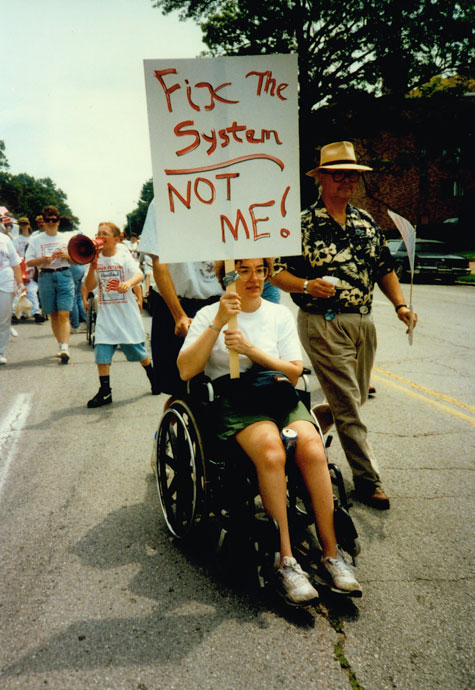
2. Look at the images carefully and share what you see.

United Spinal Association staff and members at the 2019 “Roll on Capitol Hill” disability advocacy event. CC-BY-SA-4.0

Making Change
In the past, many people with disabilities didn’t have the chance to be active members of the community. But today, many countries try to include people with disabilities in everyday life. People are pressuring their governments to make sure that people with disabilities can take part in politics, everyday life, and sports, and that’s a good change.

Photo courtesy of the Starkloff Disability Institute

Improve Access
Many countries have laws that help people with disabilities have a voice in the community. Disabled people can vote, share their ideas, and work in politics. Over time, people have fought for laws that allow disabled people to get into buildings, use public transport, and understand information. For example, many buildings now have ramps or elevators for people in wheelchairs. Buses and trains have spaces for people with disabilities. Some events have sign language interpreters or subtitles so that everyone can understand. These changes make it possible for people with disabilities to vote and be included in politics and decision-making.

Make Discrimination Illegal
The disability rights movement also fought for laws that protect all human rights. So now there are programs in many countries that support education, jobs, and healthcare for people with disabilities. For example, in the U.S., it is illegal for employers to discriminate against people with disabilities. And disabled people cannot be denied an education. Disabled people now have access to more skills and resources they need to live independently and have good lives. People with disabilities are not only getting basic support, they have the chance to achieve their goals, just like everyone else.

Image from the People’s History Museum in England. https://phm.org.uk/exhibitions/nothing-about-us-without-us-2019/

Sports for Everyone
But it’s not just about politics and services. Sports is also an important area. In the past, people with disabilities didn’t always have the chance to play sports. Now, governments are helping people with disabilities join sports activities, whether they just want to have fun or compete. There are big events like the Paralympic Games where athletes with disabilities can compete.

These events show the world that people with disabilities can be strong and successful. Local sports programs are also being created to help people with disabilities play sports in their communities. This helps improve their health, confidence, and well-being.

A Place for Everyone
For me, our society should have a place for everyone. People with disabilities have important ideas and experiences to share, and they should be included in everything. We should keep working to make sure all people can live a life that is full, active, and equal. Everyone must have the chance to be part of society. When we make room for everyone, we can create a world that is more fair and more respectful.

AFTER YOU READ:
After reading the text, studying the pictures, and watching the videos below, discuss the role of regular people in making change happen in society.

Take It Further

  1. Learn about the history of the Paralympics. Watch the video at this link: https://www.paralympic.org/ipc/history
  2. Learn about a longtime disability rights activist, Judy Heumann at this link: https://www.youtube.com/watch?v=2PnUza4FPz8

Salvador Preciado is a lawyer from Mexico with a Master’s degree in Human Rights. He has been in the United States for one year. He is an ESOL student at Chemeketa Community College in Salem, Oregon. In the future, he plans to take a course for developing his career pathway by becoming a lawyer’s assistant.

Back to Issue 66

Deafness Can Be a Strength


headphones 3 WAYS TO LISTEN

1. Click the icon on the right to listen to the full article.
2. Right-click here and “save as” or “save link as” to save an mp3 of the article to your computer.
3. Listen to sections of the article by pressing the play buttons that appear before a set of words in the article below (coming soon).

Deafness Can Be a Strength

Gustavo Pedroza Medina

BEFORE YOU READ:
1. What do you think of the title? How do you think deafness could be a strength?
2. What is an assistive technology? Share some examples of assistive technologies.
3. Think about the difference between pity and empathy. Discuss.

My Ears Stopped Hearing
When I was 25 years old, I began to notice that my hearing was fading. This was not a surprise. Since I was a child, I had been warned that I would gradually become deaf.

I am not alone. According to recent data from the World Health Organization (WHO), more than 1.5 billion people suffer from some degree of hearing loss.

I Learned to Pay Attention
Perhaps I am lucky. In my childhood, my deafness was mild, and my faith is strong. That faith gave me enough confidence to grow like any other human being. Over time, my ears stopped hearing, but they taught me something else. Being able to hear less taught me how to listen more.
In silence, I discovered the value of attention, empathy, and authentic communication.

In my mother tongue, which is Spanish, I have perfected the art of reading lips. I develop an intimate connection with people by watching them form words and make gestures. I have to pay careful attention! I hate it when it is dark. It means I can’t read your lips. When I am with other people in dark places, I turn on the flashlight of my phone. Sometimes, it’s uncomfortable, for them and for me, but little by little they have learned how important it is to me. My flashlight is a kind of assistive technology. It helps me see lips and gestures.

Extra Effort and Empathy
The extra effort that it takes to communicate has changed some of my relationships. People around me have gained empathy. They improve their way of speaking. They don’t mind me shining a flashlight at them. They make the world a little more accessible to me.

I do use hearing aids as well. These devices have allowed me to learn English, but it costs me twice the effort.

I consider myself fortunate. I am surrounded by people who don’t look at me with pity, but with empathy. My friends are people who understand and accompany. They inspire me to continue growing. They not only listen to me, they understand me. And that, in such a noisy world, is worth more than any sound.

AFTER YOU READ:
1. What are the various ways that Gustavo considers himself lucky?
2. Read Gustavo’s poem on p. 7. How does he use figurative language to convey meaning?

Gustavo P. Medina is a student at Erie Neighborhood House in Chicago, Illinois. He is passionate about communication, and he believes in the power of empathy. His journey with deafness has not been a limitation, but an opportunity to discover new ways to see, feel, and connect with the world. He firmly believes that we all have something valuable to say, if we learn to truly listen.

Back to Issue 66