1. Click the icon on the right to listen to the full article.
2. Right-click here and “save as” or “save link as” to save an mp3 of the article to your computer.
3. Listen to sections of the article by pressing the play buttons that appear before a set of words in the article below (coming soon).
What Labels Should We Use?
Mariana López
BEFORE YOU READ:
1. Read the box on the right. What are the different ways of describing people? What do you think about them?
2. What are the advantages and disadvantages of using labels to describe people?
All Kinds of People
For all of human history, there have been all kinds of people. Humans are very diverse. Some people can move their bodies very well. Others cannot move as fully. Some people have access to all five senses. Others may not be able to hear or see very well. Some people learn best one way. Others learn best a different way.
All Are Able
The problem comes when we label people as disabled. That’s a mistake. All people are able in some way! People with disabilities can do so many different things! They may not be able to do all the things that other people can do, or they may do them in a different way, but they are still able!
Access and Respect for All
People with disabilities struggle because society discriminates against them. Our buildings and sidewalks are not accessible. Schools and workplaces are not set up for people with different abilities. Sometimes, people with disabilities are treated like children, and are not given respect.
If you label someone as “disabled,” you reduce that person to their disability. People with disabilities are so much more than their condition. They deserve to be treated as what they are: a person, a human being who is able to do as many things!
AFTER YOU READ:
1. What argument is the author making? How does she make her case?
2. For another perspective, read the article on pp. 3- 4, where the two writers have different preferences for how they use the word disabled.
3. How would you describe your identity?
Mariana López is a student at Ysleta Community Learning Center in El Paso, Texas. She likes helping other people. She was raised Ciudad Juárez, Chihuahua.
1. Click the icon on the right to listen to the full article.
2. Right-click here and “save as” or “save link as” to save an mp3 of the article to your computer.
3. Listen to sections of the article by pressing the play buttons that appear before a set of words in the article below (coming soon).
Ability is NOT the Issue
Kristy Johnson and Fernanda M.
BEFORE YOU READ:
1. Note: This piece is written by a teacher, Kristy Johnson, and her student, Fernanda M., who does not want to use her full name.
2. Rehab. is short for rehabilitation. It means to make healthy again. Do you know anyone who has been in rehab.? What are examples of when we might need rehabilitation?
3. Read about the word accommodation in the box below, especially the third definition. What are some examples of accommodations at your school?
Kristy: A Brain Injury Means I Need Accommodations
I was a PE and Health teacher, personal trainer, and athlete, until I was not. A traumatic brain injury (TBI) that I got while teaching in Juvenile Detention changed my life. I was diagnosed with Ehlers Danlos Syndrome while in brain rehab.
Prior to my injury, accommodations for people with disabilities was not something I thought about very much. But when I acquired my disability, I became aware of all the obstacles that made it hard for me to participate. The simplest accommodations—no fluorescent lights, being able to work from home, a ramp—can mean the difference between me being able to participate or not.
I will never forget the moment Fernanda, a student of mine, and a wheelchair user, found out that I am disabled. She was talking about how hard her day had been, and how it had taken so long to finish her degree because remote school had not been an option, and there was no accessible transportation for her as a wheelchair user.
I said, “I understand. I am able to teach because this program is remote. If it was not, I would struggle with energy and accessibility issues too.”
“Wait a minute,” Fernanda responded, shocked. “YOU’RE disabled?! But, you’re a teacher!”
I often tell my students that the issue is not their lack of ability, but the need for accessibility. Fernanda’s shock made me realize how important disabled representation in education really is.
As our country moves to get rid of remote education, it closes doors for students like Fernanda, and for teachers like me. One of the simplest accommodations we can make is to continue offering remote work and remote education. Remember: the problem is not a lack of ability, but a lack of accessibility.
Fernanda says she does not like the term disability, because it sounds like a person is not able. I personally do not mind the word disability. I think it indicates that my ability is compromised, and I will need accommodations to be able to do something you might not need the same accommodations to do. I am still ABLE to do a lot, but I respect Fernanda’s passion and emphasis on what we CAN do. Disabled people, with the right tools and resources, ARE able.
Fernanda: I have a Disability, But I am Able
People with disabilities should have the same rights as able-bodied people. I don’t like the term “disabled,” because it sounds like you are not able to do things. There is so much I CAN do, when I have the accommodations to do it!
For example, remote classes made it possible for me to graduate high school. Then I took an interpreter course. I am now working as an interpreter. This would not have been possible without remote classes!
Also, all schools need an elevator that works, and ramps to get in the door, as well as accessible transportation. Grade-school kids can get accessible buses. Adult learners need accessible buses too. This is an equity issue, and every state should take it seriously!
I was diagnosed with HTLV (a viral infection that can affect the spinal cord), and that is why I use a wheelchair. My wheelchair helps me do more, so all I need is the buildings around me to be accessible.
Kristy and Fernanda: Make Space for Us and We Will Thrive
We support access for all. We believe that the issue is NOT ability, but accessibility. Make space for us, and we will thrive! With the right accommodations, we can participate fully! We can go to school and do our jobs. We can have dreams. We can succeed in life. We ARE able. We just need access.
AFTER YOU READ:
1. What is the main point that Kristy and Fernanda agree on?
2. What is one thing they disagree on?
3. Is public transportation accessible in your city or region? Write a letter to your local government officials, commenting on the state of accessible transportation in your area.
Kristy Johnson is a licensed teacher with over a decade of experi-ence and a passion for inclusion and accessibility. She teaches at the LARE Institute in Chelsea, MA. Kristy is an editor for “The Math Practitioner,” and she presented with the Adult Numeracy Network at COABE in 2025. She hopes to serve as Equity Officer for 2025-2026, and continue advocating for access for all in adult education.
Fernanda M. is a recent HISET graduate from the LARE Institute in Chelsea, Massachusetts. She works as an interpreter and a Lyft driver, and she is the mother of two.
1. Click the icon on the right to listen to the full article.
2. Right-click here and “save as” or “save link as” to save an mp3 of the article to your computer.
3. Listen to sections of the article by pressing the play buttons that appear before a set of words in the article below (coming soon).
Help from Neighbors Is Not Enough
Petra Hoyos
We Bring Him Food
I want to tell you about a single man. He lives near me. He lives by himself. He doesn’t have family to care for him. He can’t walk well. He uses a walker. He can’t make his own food. The neighbors take turns bringing him food.
He Needs More Help
We help him a lot, but he needs more. I try to look after him, but I can’t do enough. I can’t do it by myself. Does the government have a way to help people who are poor and disabled? We are looking for someone to help this person.
Where Does Our Tax Money Go?
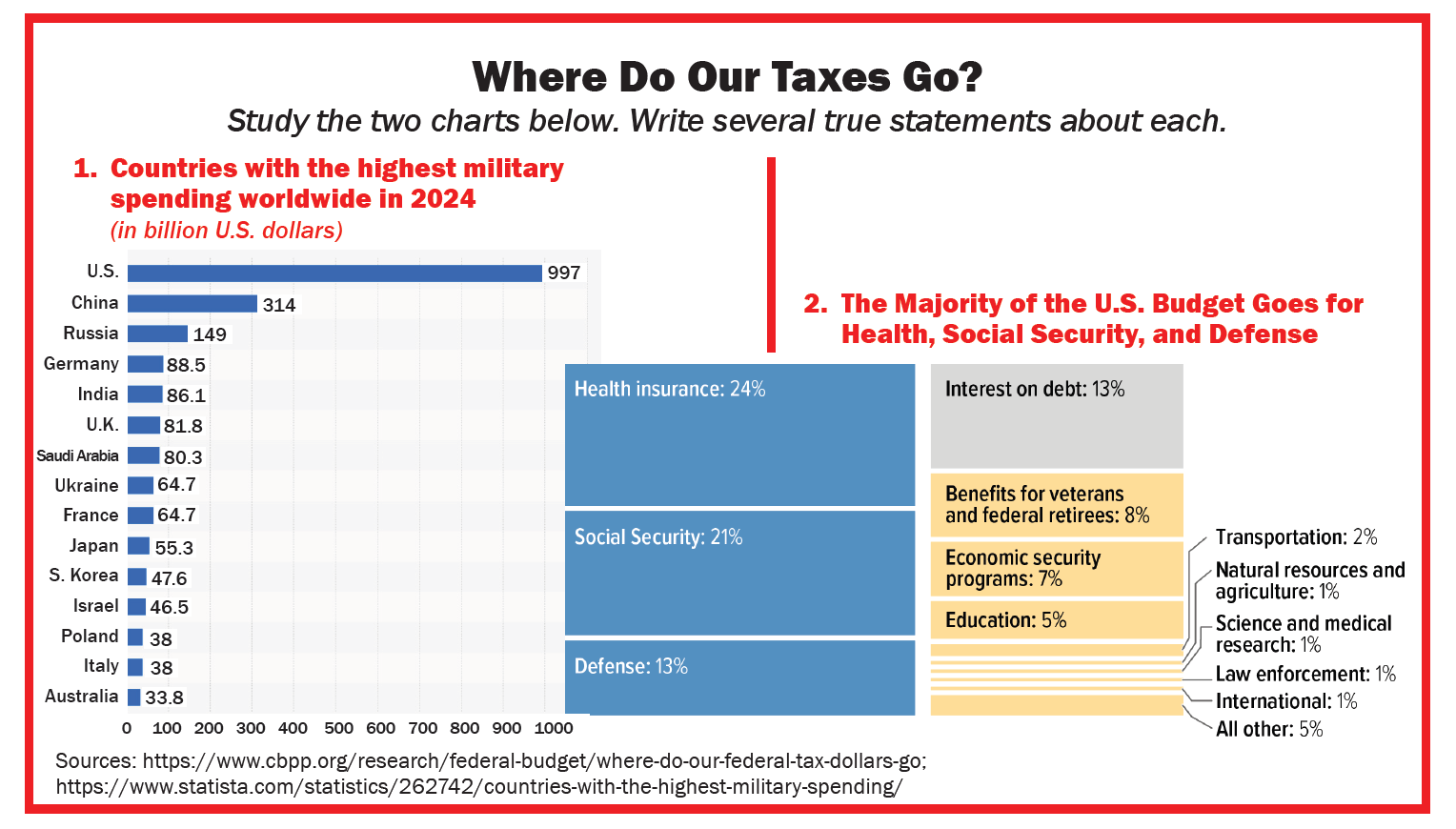
We pay taxes to the government. The government should use that money to help people. There are too many taxes on people, but there is not enough help. Where does our tax money go? Does it go to make more weapons? Or does it go to help people who are hurt?
AFTER YOU READ:
1. What is the author’s main point?
2. Look at the charts below. What do you think about military spending in the U.S.?
Petra Hoyos is a student at Ysleta Community Learning Center in El Paso, Texas. She has three grandsons. They live with her and she takes care of them because their mom died five years ago. She recently turned 60. She tries hard every day to do what is right for them, and she will continue to study to improve her English.
 3 WAYS TO LISTEN